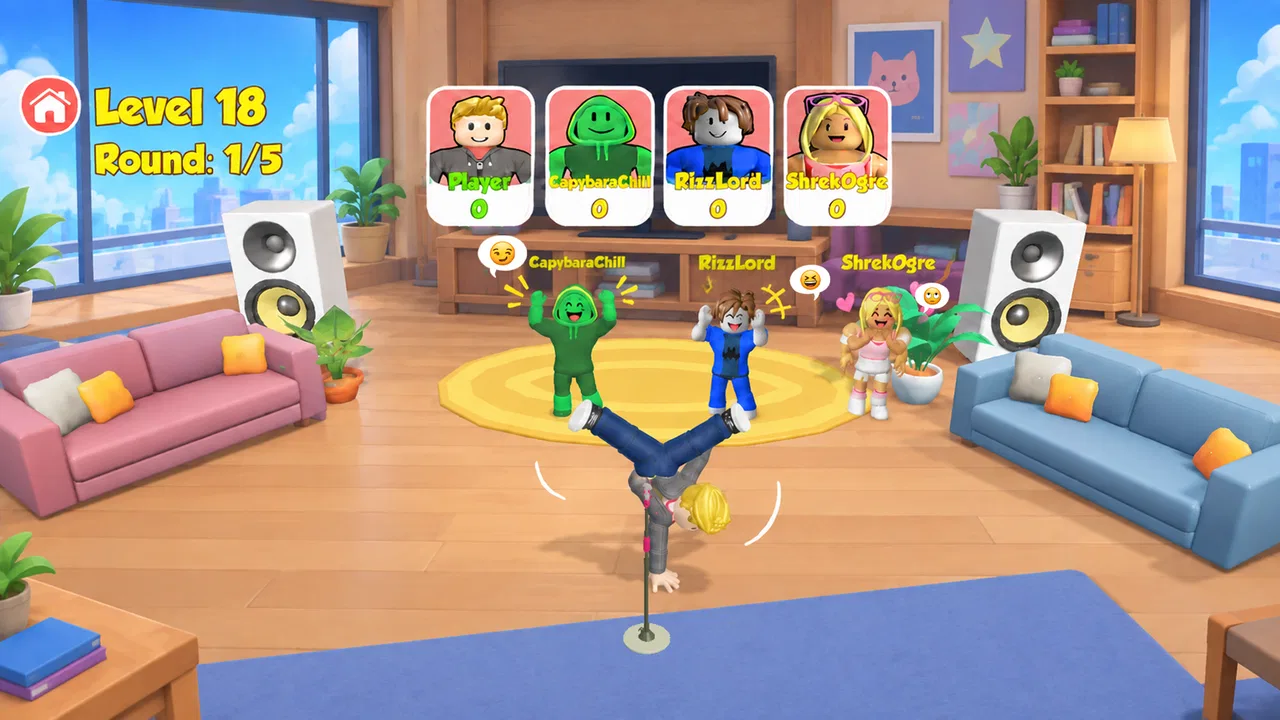
MemeMix Challenge: Funny Party
- 4.3
- Rating
- 5.00M
- Installs
- Free
- Price

 Analysis by App-foxy
I can see MemeMix Challenge: Funny Party fitting best into a living room where people already enjoy making each other laugh. The idea is to imitate comic sounds and see how you score, so the fun comes less from a long solo session and more from the reactions around the phone. I’d treat it as a quick party activity: pass the device to someone, take a turn, and let the group decide whether a convincing imitation or a hilariously bad one deserves the bigger laugh.
How it works when the phone is shared
As a casual game, it has an appealingly low-pressure premise. You do not need to settle in for a campaign or learn a complicated set of rules before inviting someone to try. The central task—mimicking funny sounds for a score—gives the group an immediate reason to participate, even if one person is holding the phone and the others are watching.
That makes it a natural fit for small gatherings, a family evening, or a dull stretch while waiting together. In a realistic use case, I’d bring it out after dinner when conversation has slowed: one person takes a turn, everyone else listens, then the phone moves to the next player. The group’s commentary can become as entertaining as the game itself, especially when people confidently attempt a sound and produce something completely different.
You May Also Like

 Blood Strike: 2.5 Anniversary
Blood Strike’s Loadouts Turn Every Drop Into a Tactical Gamble
A close look at Blood Strike’s custom loadouts: how fast access to signature weapons reshapes its battle royale rhythm, rewards preparation, and narrows the gap between fights.

 Pandora - Music & Podcasts
Pandora’s Music Is Easy to Start, but Harder to Recover
Pandora’s strength is its low-effort path from a seed to a station. Its weak spot is how much confidence it asks you to place in connection, setup, and quiet recovery.

 8 Ball Pool
 Is Built on Rivalries, Rematches, and Routine
A close look at the rivalries, rematches, shared routines, and unanswered safety questions that turn a quick pool match into a persistent mobile community.

 Samsung Music
’s Quiet Strength Is Playing What You Already Own
Its reach comes less from spectacle than from dependable access to a personal library. That simplicity is both the app’s strongest retention engine and its ceiling.

 AccuWeather: Weather Radar
AccuWeather Review: A Quick, Clear Forecast for Everyday Decisions
For everyday plans, the best forecast is the one you can understand quickly. AccuWeather makes rain timing, radar, and local conditions easy to act on, with a few trade-offs.

 Hill Climb Racing
Why Hill Climb Racing Still Turns Crashes Into One More Run
A tiny car, a bumpy hill and one more upgrade: Hill Climb Racing keeps resurfacing because its simple chaos makes every near-miss feel personal.
More From Our News Desk
View All News


The format also makes it easier to include people who are not keen on conventional mobile games. Someone who avoids timed puzzles or competitive action can still join in because the challenge is performative rather than technical. On the other hand, this is not the right pick for a quiet commute, a shared office, or a room where people do not want to make noise. The premise depends on being willing to perform, and some players may prefer to watch rather than take a turn.
Compared with the usual casual-game alternatives—solo match games, endless runners, or simple tapping challenges—this one is more social but less self-contained. Those games can occupy one person without asking anything from the room. Here, the best moments are likely to come from the people playing together, so I would not choose it as a reliable way to keep one person entertained for a long stretch.
Make a turn easy to join
For a mixed group, I’d explain the basic idea in one sentence and let the first player demonstrate. That avoids turning a quick joke into a rules briefing. It also gives shy players a chance to see the tone before deciding whether they want to try. A useful house rule is to let anyone pass without teasing; the game works better when the silliness feels invited rather than compulsory.
Another small but practical choice is to decide who holds the phone before starting. If players keep reaching across one another or debating whose turn it is, the group can lose momentum. A simple clockwise order—or letting the device move to whoever volunteers next—keeps the focus on the sounds instead of logistics. That is especially handy when children and adults are taking turns together.
Shared device, clear boundaries
Because this is a game people may pass around, I’d keep the device boundary simple: one person manages the phone, and everyone else takes their turn without changing unrelated settings or opening other apps. That is ordinary shared-device care, not a special feature of the game. If several people use the same phone, it is sensible to keep personal messages, notifications, and other private material out of view before handing it over.
I would also avoid assuming that a shared phone means shared accounts or shared purchases. The game is free to install, while in-app purchases are listed at $1.99 per item. If the device is used by children or multiple family members, the account holder should review purchase settings and make expectations clear before play. That small bit of preparation can prevent an amusing group session from becoming a conversation about an unexpected charge.
The current version is 0.0.9, so I’d keep expectations measured and check that the game behaves as intended on the device before relying on it as the main activity for a gathering. The minimum operating-system requirement is 7.1. Those details matter most when you are planning around an older phone or tablet: it is worth checking compatibility in advance rather than discovering a problem just as everyone is ready to play.
For coordination, I’d keep the session informal. Decide whether people are taking one turn each or simply volunteering, and whether the group wants to compare scores or just enjoy the performances. That distinction helps avoid a common party-game snag: one player treating the score as a serious contest while everyone else is there for the joke. If the group prefers a cooperative mood, celebrate the funniest attempt rather than making the result the only measure of success.
Age, comfort, and trust
The game is rated Everyone, which makes its intended audience broad. Even so, an age label cannot tell a parent whether a particular child will enjoy performing sounds in front of others, or whether the family is comfortable with in-app purchases. I’d introduce it as an optional group activity and let children watch before inviting them to participate. That keeps the experience welcoming for kids who are more comfortable observing at first.
For adults sharing a device with children, I’d make the account boundary explicit: the person who owns the device or store account handles purchases and settings, while players take turns in the game. There is no need to imply that the game offers family profiles or parental controls; ordinary device and account settings are the sensible place to manage those concerns. If a child is using a personal device, an adult can check the store’s purchase protections before handing it over.
Trust also includes social comfort. Sound imitation can be embarrassing for someone who dislikes being recorded or judged, so I would not pressure anyone to perform. The store summary focuses on imitation and scoring, but a group can choose its own tone: playful encouragement works better than mocking a weak attempt. If the people present are not comfortable making noise or being evaluated, a quieter game will be a better choice.
Amobear VN Game Global develops the game, which has an average rating of 4.3 from around 3,500 ratings, along with 59 written reviews. It has passed 5 million installs, suggesting that the premise has reached a sizable audience. I’d regard those figures as useful context rather than a guarantee that every household will enjoy it: a sound-based party game depends heavily on who is in the room and how willing they are to join in.
Where it fits—and where it doesn’t
The strongest reason to try it is that it can turn a phone into a shared source of laughs without asking the group to learn a deep system. That makes it a good option when you want a short, low-stakes activity and can bring together people who are comfortable being a little silly. It may also work as an icebreaker among friends who know one another well enough to laugh together, but I would not rely on it to make a reserved group instantly comfortable.
Its trade-off is that the same social focus narrows its usefulness. If you want a game that remains satisfying alone, offers a long progression, or can be played silently, a puzzle or single-player casual game is a better match. If your gathering is large, the turn-taking can also become less engaging for people waiting on the sidelines. In that situation, I’d keep sessions brief and rotate players, rather than expecting everyone to stay involved through an extended round.
The free price makes it easy to consider as a casual experiment, but the listed purchases mean “free” does not necessarily mean every optional element costs nothing. I’d start without buying anything and see whether the basic experience suits the group. That is a practical approach for a game whose main value comes from the social moment, not from collecting paid extras.
My household verdict
I’d recommend MemeMix Challenge: Funny Party to households that enjoy quick, noisy, participatory games and do not mind taking turns with one device. It is especially promising for a relaxed evening when a simple prompt can get people laughing, and the Everyone rating gives it a broad age context. The best results will come from setting a friendly tone, keeping turns moving, and letting anyone sit out without making it awkward.
I’d skip it for a household that wants quiet solo entertainment, a substantial game to return to every day, or a highly structured experience for a large group. I’d also make purchase expectations clear before sharing the phone, particularly when children use the same account. With those boundaries in place, this is a light, social option rather than a full-fledged game-night system—and that modest role is exactly where I think it makes the most sense.
FAQs for MemeMix Challenge: Funny Party
01What is MemeMix Challenge: Funny Party?
MemeMix Challenge: Funny Party is presented as a casual party game built around meme-inspired humor and quick challenges. It is intended for lighthearted play, whether you are passing time alone or sharing a laugh with friends. The exact activities and available modes can vary by version, so check the current store listing and screenshots to confirm what is included before downloading.
02Can I play MemeMix Challenge: Funny Party with friends?
The party-focused name suggests that the game is designed to make group play entertaining, but the number of players and whether everyone plays on one device or connects separately depend on the version available to you. Review the game description for multiplayer details, and check the controls before starting a session so everyone knows how to take part.
03Does MemeMix Challenge: Funny Party require an internet connection?
Whether you need internet access may depend on the game’s features and how it handles ads, updates, or online play. Some casual party games offer activities that work offline, while other functions may require a connection. For the most reliable answer, consult the app’s store page and test the game’s available modes before relying on it somewhere without internet.
04Is MemeMix Challenge: Funny Party free to download, and does it include ads or purchases?
The download price, advertising, and any optional in-app purchases can differ between platforms, regions, or app versions. Check the Google Play or Apple App Store listing for current pricing and purchase information before installing. If a child will play, review the store’s age rating and parental controls, and consider whether advertisements or optional purchases are suitable for them.
05What should I check before installing MemeMix Challenge: Funny Party?
Before downloading, confirm that the app is available for your device, meets its operating-system requirements, and has enough storage space. Read the latest user reviews and inspect the developer’s privacy information to understand what data may be collected. Also verify the game’s language, age rating, and advertised features, since these details can change with updates.
Pros
- Quick rounds make it easy to play during short breaks.
- The humorous prompts encourage lively group reactions.
- Simple rules help new players join without a long tutorial.
- A good fit for casual parties and relaxed get-togethers.
- The meme theme gives familiar humor a playful twist.
Cons
- The fun depends heavily on having an engaged group.
- Some jokes may not land with every player.
- Repeated prompts can make sessions feel less fresh.
- It offers limited appeal for people who prefer solo games.
- Humor-focused challenges may not suit younger players.

MemeMix Challenge: Funny Party
Gallery